
Good home movie theater design has very little to do with which projector you choose or how many speakers you order. It starts with the room itself. Before a single piece of equipment is selected, the space needs to be understood: its dimensions, its acoustics, how light enters it, how sound will behave inside it. Get those fundamentals right, and the technology you layer in afterward will perform the way it should. Skip that step, and even the most expensive gear will underdeliver.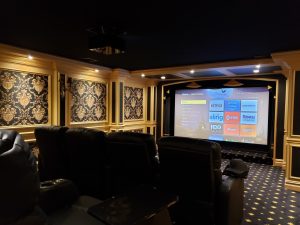
We’ve been doing this for over two decades, and the single most common issue we see in poorly performing home theaters is that the room was an afterthought. Someone picked a screen size, bought a receiver, mounted some speakers, and then wondered why the experience felt flat. The room is not just a container for the equipment. It is part of the system.
Room Acoustics Are the Foundation
Sound is physical. It bounces off hard surfaces, gets absorbed by soft ones, and builds up in corners. A room with parallel walls and no acoustic treatment will produce standing waves and flutter echo that muddy dialogue and smother musical detail. No amount of speaker quality fixes that problem after the fact.
When we work on a home theater project, whether in Saddle River, NJ, Franklin Lakes, NJ, or across the river in Bronxville, NY or Scarsdale, NY, we look at the room’s proportions early in the planning process. We consider ceiling height, wall materials, flooring, and whether the space is a dedicated room or a dual-purpose living area. From there, acoustic panels, bass traps, and strategic soft furnishings get worked into the design in a way that complements the aesthetic rather than fighting it. Our clients are investing in beautiful spaces, and acoustic control should be invisible.
Light Control Matters More Than Most People Expect
Contrast ratio is one of the most important factors in picture quality, and it is largely determined by ambient light. A projector with outstanding specs will look mediocre in a room with uncontrolled daylight. This is why we work with Lutron motorized shades and architectural lighting control from the start of a project, not as an add-on at the end.
In a properly designed home cinema, the lighting does several things at once. Bias lighting behind the screen reduces eye strain and improves perceived contrast. Scene-based lighting presets dim the room the moment a film starts, and come back up gently during intermissions. Blackout shades eliminate every trace of daylight. These elements are coordinated through a control system, typically Crestron or Control4, so the entire experience is triggered by a single button press or a tap on a touchscreen.
For clients in Tenafly, NJ and the surrounding areas, where homes often feature large windows and open floor plans, this kind of light management is especially important. A room that was designed without it becomes a compromise.
The Room Informs Every Equipment Decision
Once acoustics and light are accounted for, the equipment choices become much more straightforward. Seating distance from the screen determines the ideal screen size. Screen size and ambient light levels together determine whether a projector or a direct-view display is the better fit. Room volume shapes the speaker placement and the subwoofer configuration. Everything connects.
This is why we bring in our design perspective early, often collaborating with the architect, interior designer, or builder before construction is finished. In new builds and major renovations across communities like Franklin Lakes, NJ and Saddle River, NJ, we have the opportunity to wire for the future, plan sight lines, and specify in-wall or in-ceiling speaker locations that will disappear into the finished room. That level of coordination produces results that simply cannot be replicated when AV is bolted onto a completed space.
Technology Should Feel Effortless
A well-designed home theater is not something you operate. It is something you enjoy. The controls should be intuitive enough that anyone in the family can use the room without a learning curve. The system should be documented, supported, and easy to update as your needs change. Jason and our team stay involved with clients long after installation, which is why some of our relationships in the Saddle River area have continued for nearly a decade.
The premium brands we work with, including SIM2 projectors, AudioControl amplification, and Crestron or Control4 automation, are selected because they perform reliably at a high level over the long term. But they perform best when the room was designed to support them from the beginning.
If you are planning a home cinema in northern New Jersey, Bronxville, Scarsdale, or anywhere in the surrounding areas, we would love to talk through the project with you. Give us a call or drop us an email, and we can start with the room.