
Home theater system design is really where the magic happens, long before any equipment arrives on-site or any cable is pulled through a wall. The decisions made at the planning stage determine whether your finished theater feels effortless and immersive, or whether you’re left troubleshooting quirks and compromises for years to come. After more than two decades of designing and installing custom AV systems across North and Upper-Central New Jersey and New York City, we’ve learned that a great home theater is built on paper first.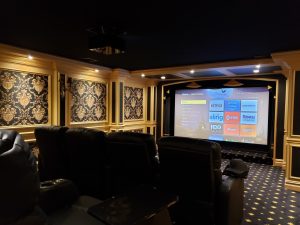
It Starts With the Room, Not the Equipment
Every project we take on begins with a close look at the space itself. Room dimensions, ceiling height, wall materials, windows, HVAC placement, and even the direction the room faces all influence the final design. A theater in a Saddle River estate with 12-foot ceilings calls for a very different approach than a dedicated cinema room in a Tenafly townhouse or a basement conversion in Ridgewood. Before we ever recommend a screen size or a speaker brand, we need to understand what the room will allow.
Acoustics are a huge part of this conversation. Hard surfaces reflect sound in ways that can undermine even the finest equipment. So we look at how the room will be treated, whether that means fabric wall panels, acoustic ceiling clouds, or specific flooring choices, and we factor all of that into speaker placement and calibration plans. This kind of thinking cannot be retrofitted easily. It has to be part of the design from day one.
How We Coordinate With Architects, Builders, and Designers
Many of our clients in Alpine, Ridgewood, and Scarsdale are in the middle of a new build or a significant renovation when they come to us. That timing is actually ideal, because it gives us the opportunity to work directly alongside the architect and builder to make sure the infrastructure is built into the structure of the home correctly. Conduit runs, in-wall wiring pathways, equipment room placement, power circuits for dedicated amplifiers and processors, HVAC for the equipment rack, all of this gets coordinated before the walls are closed.
When AV is treated as an afterthought, things get complicated fast. Walls have to be opened, soffits get added where they weren’t planned, and the result rarely looks or performs as well as it should. Working collaboratively from the design phase is simply the right way to do it, and it’s how we’ve approached projects in communities from Tenafly to Scarsdale and surrounding areas for years.
Choosing the Right Technology for the Right Client
We work with premium brands like Crestron, Control4, SIM2, AudioControl, and Lutron, and each of them has strengths that make them the right fit for certain applications. A two-zone whole-home audio setup is a very different conversation from a dedicated 7.1 or Dolby Atmos cinema room. Our job is to match the technology to the client’s lifestyle and the room’s capabilities, not to sell a particular package.
Jason, who leads our team and stays personally involved in projects, takes time with every client to understand how they actually plan to use the space. Is this a room primarily for film and TV? Will it double as a music listening room? Do the kids need simple, one-touch control? Will the system integrate with lighting, automated shades, and the rest of the home? Those answers shape every specification on the design document.
Documentation and the Path to a Clean Installation
Once the design is finalized, everything gets documented. Wiring diagrams, equipment schedules, rack layouts, control system programming notes. This level of detail is what allows installation to move efficiently, and it’s also what makes long-term support straightforward. When a client in Saddle River who has worked with us for nearly a decade picks up the phone with a question, we can pull up the documentation and help them quickly, because the system was designed and recorded properly from the start.
That kind of long-term relationship is something we genuinely value. A home theater should be easy to use, reliable, and supported well after the final walkthrough. Good documentation, combined with a design that was thoughtful at every stage, is what makes that possible.
If you’re planning a new build, a renovation, or simply thinking about what a proper home theater could look like in your home, we’re happy to talk through the details with you. Give us a call or drop us an email, and we’ll start from the beginning, which is exactly where a great home theater system should start.